2200 AW Grimes Blvd, Suite 100 Round Rock, TX 78665

Getting dental implants is a significant investment in your smile, your comfort, and your long-term oral health. So it's completely reasonable to want to protect that investment with the best possible care. One question that comes up surprisingly often once patients get home is whether their electric toothbrush is safe to use on implants, or whether they should switch to something gentler.
The short answer is yes — electric toothbrushes are usually safe for dental implants and are recommended by many dental professionals. But the complete answer includes understanding why implant hygiene matters so much, what to look for in a toothbrush, and how your cleaning routine needs to adapt now that you have implant-supported restorations.
Why Implant Hygiene Is Different From Natural Tooth Care
The Tissue Around an Implant Doesn't Have the Same Defenses
Natural teeth have a periodontal ligament (a thin layer of connective tissue that attaches the tooth root to the surrounding bone). This ligament contains blood vessels and nerve fibers that contribute to the tooth's immune defense, helping signal early signs of bacterial invasion and inflammation.
Dental implants integrate directly with the jawbone through osseointegration, bypassing this ligament entirely. That means the soft tissue seal around the implant (called the peri-implant mucosa) is structurally different from the gum tissue around natural teeth. It's thinner, has a more limited blood supply, and lacks some of the natural defenses that gum tissue around teeth possesses.
This difference matters because it makes the tissue around implants more vulnerable to a condition called peri-implantitis - a bacteria-induced inflammatory disease affecting the gum and bone surrounding an implant. Peri-implantitis is essentially the implant equivalent of periodontal disease, and it's one of the leading causes of implant failure when left unaddressed.
For patients who've received dental implants in Round Rock at Chandler Creek Dental Care, the hygiene guidance provided after placement isn't generic advice — it's a specific protocol designed to protect the peri-implant tissue from the bacterial accumulation that drives this condition.
Source: Teeth Talk Girl
Electric Toothbrushes and Implants: What the Research Shows
Sonic and Oscillating Brushes Both Perform Well
Multiple clinical studies have evaluated the safety and effectiveness of electric toothbrushes around implant-supported restorations, and the evidence consistently supports their use. A review published in the Clinical Oral Implants Research journal found that both sonic and oscillating-rotating electric toothbrushes effectively reduce plaque around implants without damaging the implant surface, the crown, or the surrounding soft tissue when used with an appropriate technique.
The advantage of electric toothbrushes (consistent oscillation speed, built-in timers, and pressure sensors on many models) makes them superior to manual brushes for most patients in terms of plaque removal efficiency. For implant patients specifically, this matters because plaque biofilm at the peri-implant margin is the primary driver of peri-implant mucositis, which is the early, reversible form of peri-implant inflammation.
Catching and removing plaque consistently at the gumline around each implant is where electric toothbrushes earn their advantage. The challenge with manual brushing is that most people apply inconsistent pressure and miss the same areas repeatedly, often the lingual (tongue-side) surfaces and the margins where the crown meets the gum.
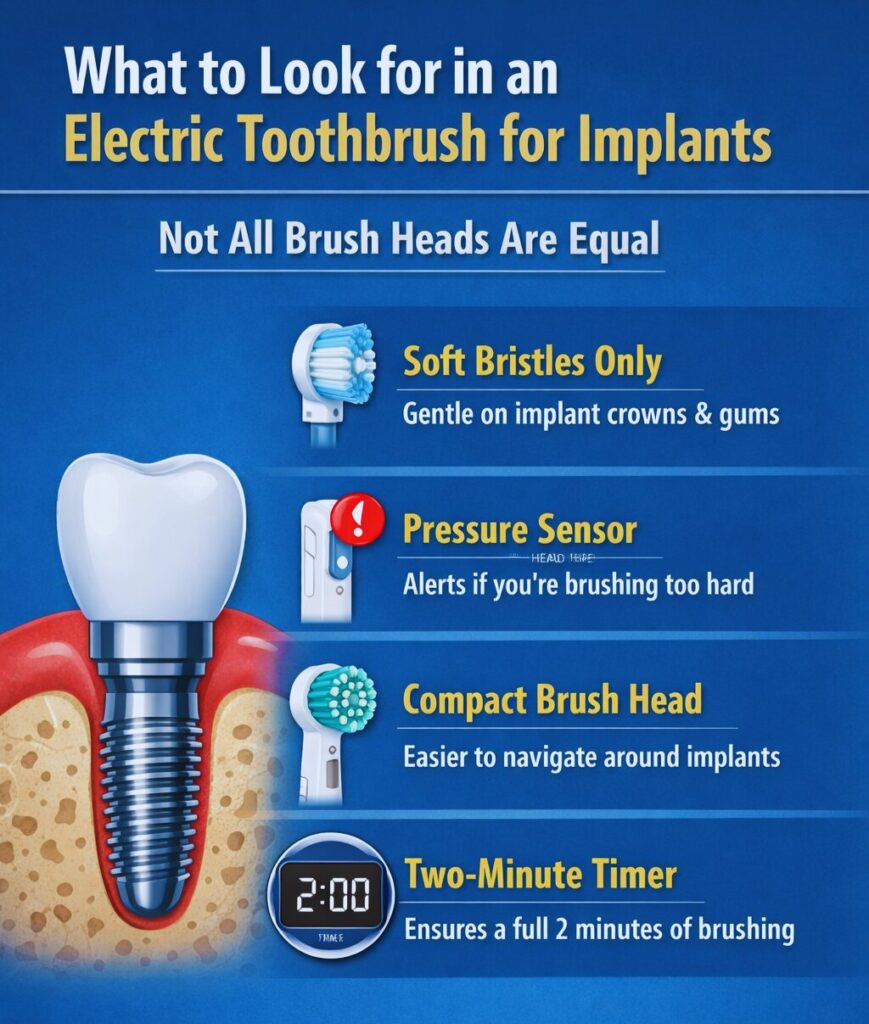
What to Look for in an Electric Toothbrush for Implants
Not All Brush Heads Are Equal
The implant crown (the visible tooth-shaped restoration attached to your implant) is made from porcelain, zirconia, or a composite material. These surfaces are durable but can be scratched by abrasive bristles or excessive mechanical force over time. Here's what to prioritize:
- Soft bristles only. Medium or hard bristles, combined with the oscillation speed of an electric toothbrush, can be too aggressive against the soft tissue margin around an implant and can eventually scratch restoration surfaces. Soft or extra-soft bristle heads are the appropriate choice.
- A pressure sensor feature. Many mid-range and premium electric toothbrushes include a sensor that alerts you when you're pressing too hard. For implant patients, this is genuinely useful — peri-implant tissue is less tolerant of mechanical trauma than gum tissue around natural teeth.
- A round, compact brush head. Smaller brush heads maneuver more easily around implant-supported crowns, particularly in posterior areas where spacing is limited and reaching all surfaces takes more effort.
- A built-in two-minute timer. The ADA recommends two minutes of brushing, and a timer removes the guesswork for patients who tend to rush through their routine.
Sonic toothbrushes, which use high-frequency vibration rather than a rotating motion, are a popular choice among implant patients because some find the fluid dynamics of sonic vibration effectively cleans slightly beneath the gumline. Both sonic and oscillating-rotating models are clinically appropriate; the best choice is the one you'll use consistently and correctly.
Brushing Technique Around Implants
Angle, Pressure, and Consistency Are Everything
Owning the right toothbrush matters less than using it correctly. The goal when brushing around implants is to disrupt plaque at the peri-implant margin without traumatizing the surrounding soft tissue.
Position the brush head so the bristles contact the gumline at roughly a 45-degree angle, similar to the Bass technique used for natural teeth, and allow the brush to do the work. You're guiding it, not pressing it. Make sure you're reaching all surfaces of each implant-supported crown: the cheek-facing surface, the tongue-facing surface, and the biting surface.
Pay particular attention to the gumline margin. That's where plaque accumulates most rapidly and where peri-implant mucositis begins. A few extra seconds of focused attention at the margin of each implant crown makes a measurable difference in tissue health over months and years.
Patients across Round Rock and the surrounding Williamson County area who've had implants placed at Chandler Creek Dental Care receive specific brushing guidance at their post-placement appointments. If you're uncertain whether your current technique is adequate, your next maintenance visit is a good opportunity to ask your hygienist to walk you through it.
What Else Your Implant Hygiene Routine Needs
Brushing Alone Isn't enough.
Even perfect brushing doesn't reach the interproximal surfaces - the spaces between teeth and between the implant crown and adjacent teeth. These surfaces require dedicated cleaning tools.
Water flossers are well-suited for implant maintenance. The pulsating water stream cleans beneath the gumline and between implant crowns without the risk of snapping floss against delicate peri-implant tissue. A Waterpik or similar device on a medium setting directed at the gumline around each implant is a practical, effective daily addition.
Implant-specific floss or tape — such as products designed with a stiff end threader and a spongy middle section — can access the contact areas between implant crowns and adjacent natural teeth. If you're using traditional floss, wrap it in a C-shape around the implant and move it gently at the gumline rather than snapping it through the contact.
Antimicrobial mouthwash used as part of your evening routine adds a layer of bacterial control beyond what teeth cleaning alone provides - useful for patients prone to plaque buildup or with a history of gum disease.
Electric toothbrushes and dental implants are genuinely compatible - the key is to use the right brush, the right technique, and the right supporting tools. Chandler Creek Dental Care serves patients throughout Round Rock and the wider central Texas area, and the team is ready to answer any questions about your implant maintenance routine at your next visit. Call today or book your appointment online to keep your implants healthy for the long term.
People Also Ask
Can electric toothbrush vibrations loosen a dental implant?
No. A properly osseointegrated implant is fused with the jawbone and won't be affected by the vibration of an electric toothbrush. If an implant feels loose, that indicates a clinical issue unrelated to brushing - contact your dentist promptly.
How soon after implant surgery can I use an electric toothbrush?
Most dentists recommend returning to an electric toothbrush four to six weeks after implant placement, once initial healing is complete. During the early healing phase, a soft manual brush is used very gently around the surgical site.
Is a water flosser better than regular floss for implants?
Both have a role. Water flossers clean beneath the gumline and between crowns effectively and are particularly gentle on peri-implant tissue. Traditional floss or implant-specific tape adds physical contact cleaning at the crown margin. Using both provides the most thorough coverage.
How often should implant patients have professional cleanings?
Most implant patients benefit from professional maintenance every three to four months rather than the standard six-month interval, at least in the first few years after placement. Your dentist will recommend a schedule based on your tissue health and plaque response.
Can I use whitening toothpaste on my implant crowns
Most whitening toothpastes contain abrasives that can scratch porcelain or composite crown surfaces over time. A low-abrasion toothpaste is a better choice for implant patients - whitening agents won't change the color of the crown material anyway, so whitening toothpaste offers no benefit there.